
Introduction
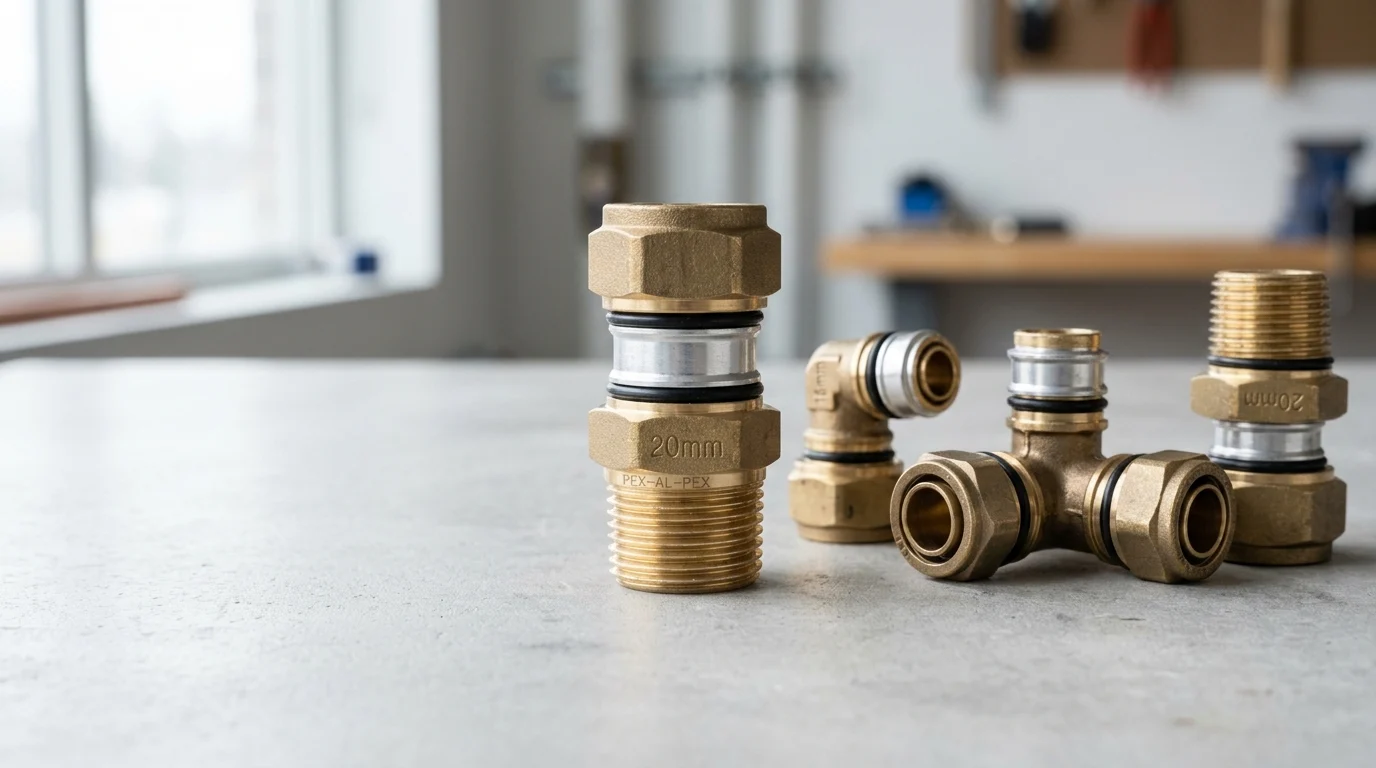
Reliable connections are critical in multilayer plumbing and hydronic systems, where PEX-AL-PEX pipe must handle pressure, temperature changes, and long-term service without leaks or joint failure. Compression fittings offer a practical mechanical solution, combining secure pipe grip, dependable sealing, and straightforward installation without soldering or complex tools. This guide explains how these fittings work, what features make them suitable for potable water and heating applications, and what to consider before selecting or installing them. It also outlines the basic installation process and key checks that help ensure a durable, professional-quality connection.
Why PEX-AL-PEX Compression Fittings Matter
Multilayer pipes combining cross-linked polyethylene and an internal aluminum core have transformed modern plumbing and hydronic heating. To maximize the structural integrity and longevity of these systems, PEX-AL-PEX compression fittings provide a secure, mechanical joint that requires minimal specialized equipment to execute.
Unlike traditional copper soldering or rigid solvent-welded plastics, multilayer systems require specialized mechanical grips to seal both the inner fluid pathway and protect the multi-layered pipe wall. Compression fittings serve as a primary connection methodology that balances high pressure tolerances with field adaptability.
Problems They Solve
The primary advantage of this connection method lies in its ability to address common vulnerabilities in hydronic and potable water systems. Standard polymer pipes suffer from oxygen permeation and significant thermal expansion. The aluminum core in PEX-AL-PEX mitigates these issues, but the connection points remain potential weak links. Compression fittings solve this by utilizing dual internal O-rings and a mechanical split-ring mechanism that grips the pipe securely, preventing blow-offs even under fluctuating line pressures.
Furthermore, the combination of the fitting’s brass insert and the pipe’s aluminum layer restricts the coefficient of linear expansion to approximately 0.025 mm/mK, vastly outperforming standard PEX which typically expands at a rate of 0.15 mm/mK. This mechanical synergy prevents the pipe from sagging or pulling out of the fitting during high-temperature heating cycles.
Cost, Reliability, and Labor Impact
While individual compression fittings typically cost 15% to 25% more per unit than their crimp or press equivalents, the overall economic impact on a project is highly favorable for specific operational scales. The most significant cost reduction stems from the elimination of specialized labor and tooling.
Battery-operated press tools and calibrated jaw sets can require an initial capital investment exceeding $1,500. By relying on standard adjustable wrenches, compression fittings eliminate this high barrier to entry. This makes them highly reliable and cost-effective for localized repairs, custom residential builds, and complex multi-zone heating manifolds where micro-adjustments are frequently required to balance system flow.
Components and Applications
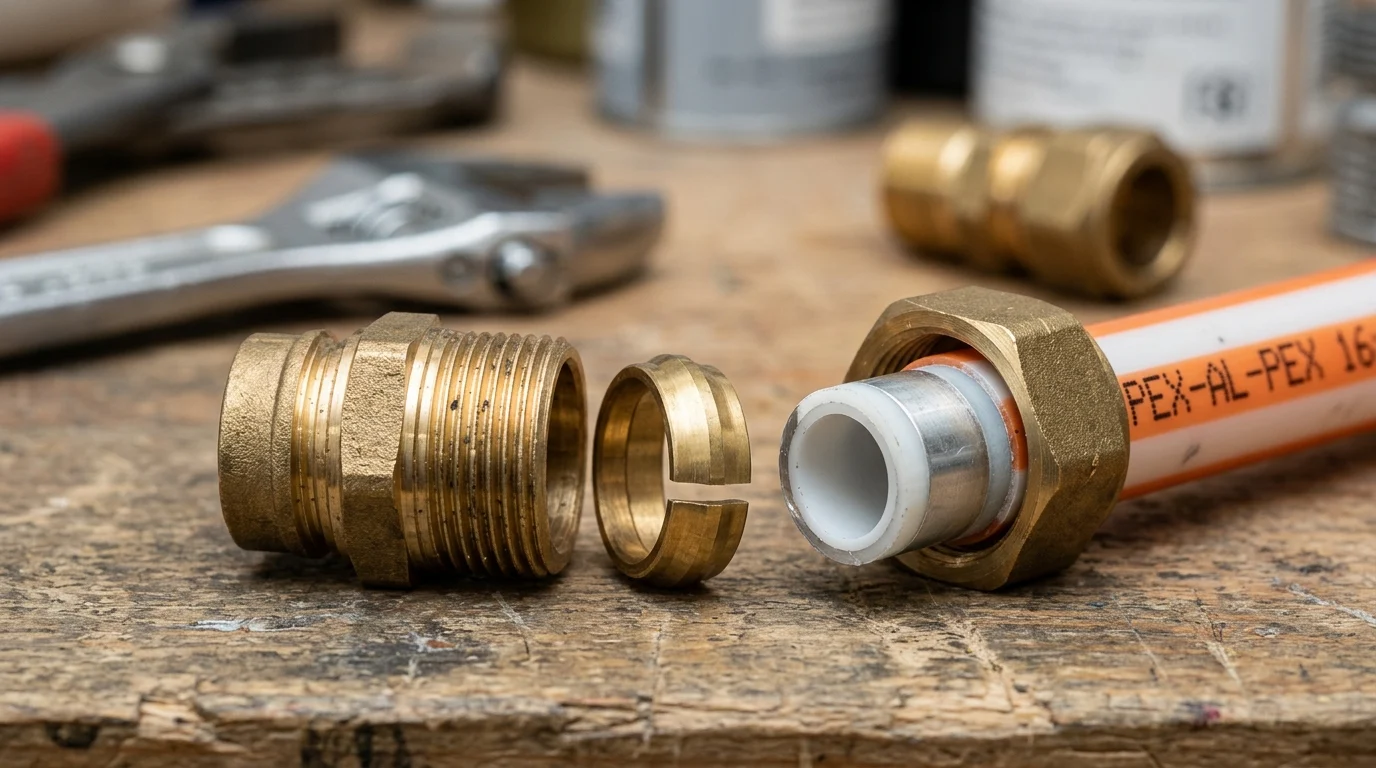
Understanding the mechanical design of a PEX-AL-PEX compression fitting is essential for specifying the correct hardware for plumbing and heating networks. The synergy between the multilayer pipe structure and the multi-part brass fitting ensures a leak-free operational life across varied environments.
Key Fitting Parts
A standard compression fitting consists of four primary engineered components: the main brass body equipped with a barbed or ribbed insert, dual EPDM (Ethylene Propylene Diene Monomer) O-rings seated within the insert’s machined grooves, a brass or stainless steel compression ring (often called an olive or split ring), and the heavy-duty outer compression nut.
When the installer tightens the nut, it forces the split ring to compress against the outer polyethylene layer of the pipe. Simultaneously, the internal O-rings are compressed against the inner PEX layer, forming a watertight, double-redundant seal that isolates the fluid from the aluminum core.
Aluminum Core Benefits
The effectiveness of the compression fitting is heavily reliant on the PEX-AL-PEX pipe’s central aluminum core. This metallic layer provides critical form stability, meaning the pipe retains its exact shape after bending and resists the “spring-back” effect common in pure polymer pipes. This prevents lateral stress on the fitting joint over time.
More importantly, the aluminum acts as a 100% effective oxygen barrier. When paired with a properly torqued compression fitting equipped with a dielectric separation ring, it prevents oxygen ingress that would otherwise cause accelerated oxidation and corrosion in downstream boiler components, pumps, and ferrous heat exchangers.
Common Plumbing and Heating Uses
These specialized fittings are predominantly utilized in radiant underfloor heating (UFH) systems, high-temperature radiator circuits, and commercial potable water distribution. In UFH manifolds, compression fittings are the undisputed industry standard because they allow for individual loop isolation, balancing, and replacement without ever needing to cut the pipe.
They are engineered to handle demanding operational parameters, frequently rated for continuous service at 10 bar of pressure at temperatures reaching 95°C, with short-term peak tolerances engineered to withstand up to 110°C during temporary boiler malfunctions or thermal spikes.
Comparison with Other Connection Methods
Selecting the appropriate connection methodology dictates the speed, upfront cost, and long-term serviceability of a plumbing installation. PEX-AL-PEX compression fittings offer distinct operational advantages and trade-offs when evaluated against alternative joining techniques.
Compression vs Crimp, Press, and Push-Fit
| Feature | Compression | Press Fitting | Push-Fit |
|---|---|---|---|
| Tooling Required | Standard Wrenches | Hydraulic Press Tool | Pipe Cutter Only |
| Installation Speed | Moderate | Fast | Very Fast |
| Demountability | Yes (Fully Reusable) | No (Must be Cut) | Varies (Special Tool) |
| Estimated Unit Cost | High ($3.00 – $8.00) | Low ($1.50 – $4.00) | Very High ($5.00+) |
Compared to press and crimp systems, which permanently deform a metal sleeve over the pipe, compression fittings rely on threaded mechanical force. While push-fit connections offer the absolute fastest installation, they rely heavily on internal grab-rings that can be sensitive to exterior pipe scratches and high-temperature cycling. Compression fittings provide a superior mechanical grip that is highly resistant to vibration and thermal shock.
Tooling, Access, and Serviceability
The defining trait of compression fittings is their exceptional serviceability. Because the connection is made via a threaded nut, the joint can be fully disassembled at any point in its lifespan. If a manifold needs to be relocated or a zone valve replaced, the nut can simply be backed off.
While the pipe end may need to be re-calibrated and a new $0.50 split ring applied for optimal safety, the primary, expensive brass fitting body remains completely reusable. This contrasts sharply with press fittings, which necessitate cutting the pipe and discarding the fitting entirely, often resulting in a permanent loss of 2 to 3 inches of pipe length per repair.
Best Use Cases for Retrofit Work
Retrofit and historical renovation projects frequently present challenging environments where wall and floor access is severely restricted. A standard hydraulic press tool requires a minimum clearance of 4 to 6 inches to properly engage the heavy metal jaws around the fitting.
In tight joist bays, directly behind existing cabinetry, or within dense mechanical chases, maneuvering a bulky press tool is often physically impossible. Compression fittings excel in these exact scenarios, requiring only the fractional turning radius of an open-ended wrench or basin wrench to achieve the required clamping torque.
Selection and Compliance Criteria
Ensuring long-term reliability in hydronic and potable systems requires strict adherence to material specifications and international manufacturing standards. Specifying an incompatible or substandard component can lead to catastrophic system failure and severe water damage.
Material, Pressure, and Temperature Ratings
Industrial standards dictate the performance thresholds for multilayer pipe fittings. Systems must typically conform to ISO 21003, EN 1224, or equivalent regional benchmarks like AS4176. Quality compression fittings are rated for a nominal pressure (PN) of PN16 (16 bar) at ambient room temperatures of 20°C.
However, mechanical engineers must account for thermal derating at elevated temperatures; a system rated for 16 bar at 20°C is typically only certified to safely hold 10 bar at 85°C. Verifying these derating curves with the manufacturer is critical for commercial boiler applications.
Brass Grade, Seals, Threads, and Pipe Compatibility
| Component | Material Standard | Application Note |
|---|---|---|
| Standard Brass Body | CW617N | Suitable for standard closed-loop heating and non-aggressive water. |
| DZR Brass Body | CW602N / CW511L | Required for aggressive potable water (dezincification resistant). |
| O-Rings | Peroxide-cured EPDM | High thermal resistance up to 120°C; resistant to glycols. |
Dimensional compatibility is equally critical. PEX-AL-PEX pipes vary significantly in wall thickness based on the manufacturer; a standard 16mm outer diameter pipe might have a 2.0mm or 2.25mm internal wall. A compression fitting designed specifically for a 16×2.0mm pipe will fail if forced into a 16×2.25mm pipe, either by shearing the O-rings during insertion or failing to provide adequate internal flow area.
Common Sourcing and Quality Risks
The global plumbing supply chain presents several quality risks for procurement teams. The most common regulatory risk is the use of substandard brass alloys containing lead levels exceeding the 2.2% limit mandated by older potable water regulations, or failing to meet newer low-lead standards that cap lead content at ≤0.25%.
Additionally, low-cost manufacturers may use inferior NBR (Nitrile) rubber instead of genuine peroxide-cured EPDM for the internal O-rings. NBR is prone to rapid degradation, hardening, and eventual leaking when exposed to chemical heating system inhibitors or sustained fluid temperatures above 70°C.
Installation and Recommendation
The hydrostatic integrity of a PEX-AL-PEX compression joint is entirely dependent on correct preparation and meticulous assembly. While the process requires minimal tooling, strict adherence to the sequential installation steps is non-negotiable for a leak-free guarantee.
Step-by-Step Installation Process
The installation sequence begins with a clean, perfectly 90-degree square cut using specialized ratcheting pipe shears. The most critical subsequent step is calibration and chamfering. A specialized calibration tool must be inserted into the pipe and rotated fully to restore the pipe’s perfectly circular shape (which is often ovalized during cutting) and carve a precise 2mm to 3mm internal bevel.
Next, the compression nut and the split ring are slid sequentially onto the pipe exterior. The brass fitting body is then pushed firmly into the pipe until the pipe end sits flush against the fitting’s dielectric stop ring. Finally, the nut is threaded onto the body and tightened—typically hand-tight followed by exactly 1 to 1.5 full turns with a properly sized wrench.
Common Installation Errors
The overwhelming majority of joint failures stem from skipped preparation steps rather than defective hardware. Failing to chamfer the inner PEX layer leaves a sharp plastic edge that will catch and aggressively dislodge the EPDM O-rings during insertion, pushing them out of their machined grooves and guaranteeing a pressurized leak.
Another frequent error is severe over-tightening. Applying excessive torque (generally exceeding 30 to 40 Nm, depending on the pipe diameter) can distort the brass split ring, permanently crush the pipe’s internal aluminum core, or induce microscopic stress fractures in the brass nut, particularly when installed in near-freezing environments.
When to Specify Compression Fittings
Specification of compression fittings is highly recommended for underfloor heating distribution manifolds, temporary construction water supplies, custom radiator drops, and modular building connections where future disassembly or flow adjustment is anticipated.
For large-scale commercial domestic water risers requiring hundreds of repetitive joints, press fittings may offer superior overall labor efficiency. However, for specialized hydronic applications, low-volume emergency repairs, and scenarios demanding precise adjustability without heavy machinery, PEX-AL-PEX compression fittings remain an unmatched, highly resilient engineering solution.
Key Takeaways
- The most important conclusions and rationale for PEX-AL-PEX Compression Fittings
- Specs, compliance, and risk checks worth validating before you commit
- Practical next steps and caveats readers can apply immediately
Frequently Asked Questions
What are PEX-AL-PEX compression fittings used for?
They connect multilayer PEX-AL-PEX pipes in potable water, radiator, and underfloor heating systems, creating a secure mechanical seal without soldering or press tools.
Why choose compression fittings over press or crimp fittings?
They need only standard wrenches, reduce tooling costs, and are practical for repairs, manifolds, and custom installations where adjustments may be needed.
How do PEX-AL-PEX compression fittings prevent leaks?
A split ring grips the pipe exterior while internal O-rings seal against the inner PEX layer, creating a tight double-seal connection.
Are PEX-AL-PEX compression fittings suitable for heating systems?
Yes. They are commonly used in radiant floor heating and radiator circuits, especially where stable pipe shape and oxygen-barrier performance are important.
What should installers check before tightening the fitting?
Ensure the pipe is cut square, calibrated, fully inserted, and that O-rings and the compression ring are correctly positioned before tightening the nut.
References
- PEX Compression Fittings: A Step-by-Step Guide – Tubomart
- How to Make a PEX-AL-PEX Compression Fitting Connection
- how to install PEX-AL-PEX Pipes – YouTube
- Understanding PEX-AL-PEX Compression Fittings: The Future of …
- [PDF] PEX Plumbing Design Guide – Chapter 9 Installation
- PEX-AL-PEX Compression Pipe Fitting Guide 101 – Plumberstar
- [PDF] PEX PIPING SYSTEM INSTALLATION GUIDE – Jones Stephens
- How To Install PEX Compression Fittings Step By Step – Knowledge
- A Beginner’s Guide to PEX-AL-PEX Fittings | Tubomart
- PEX A Plumbing Made Easy: Must-Know Tips for Beginners
Post time: Jun-17-2026